




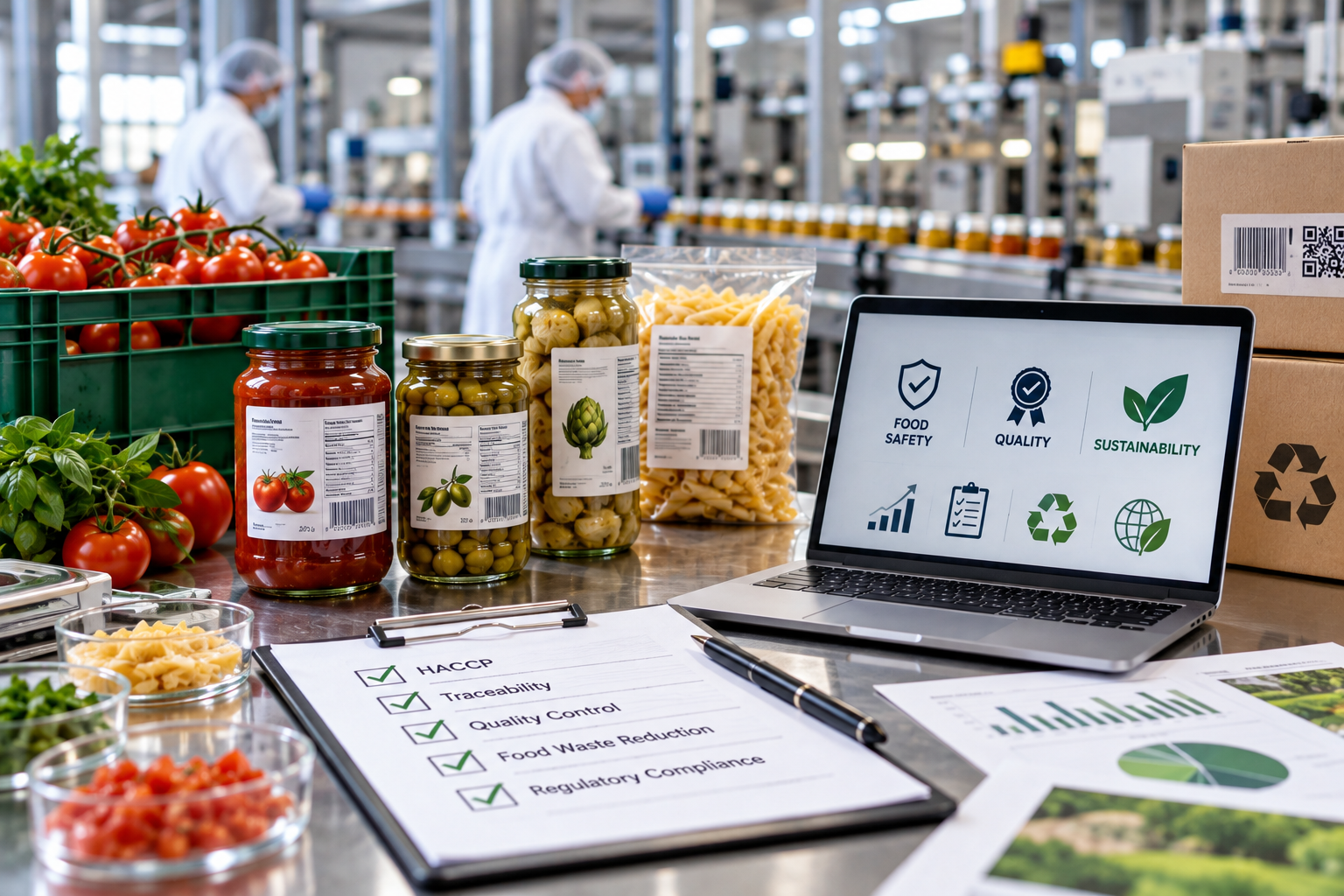
For a food and beverage business, safety, quality and sustainability are often treated as three separate areas of compliance. In practice, they function as an integrated system: food safety ensures access to the market, consistent quality encourages customers to return, and documented sustainability creates differentiation and reduces costs. In 2026, all three areas became subject to new, specific requirements.
The Food Safety Framework and the Implementation of HACCP
The foundation remains Regulation (EC) No 178/2002 and Regulation (EC) No 852/2004, which apply to all food businesses, regardless of their size. The system of self-monitoring based on HACCP principles is implemented proportionately: the seven principles remain the same for everyone, but the level of documentation is adapted to the size and nature of the business, as clarified in Commission Notice 2022/C 355/01. Since 2021, under Regulation (EU) 2021/382, food safety culture has been an explicit legal obligation, encompassing management commitment, staff training and open communication about risks.
Allergens require particular attention. Unlike microbial hazards, they are not eliminated through heat treatment and there is no single safe threshold applicable to all consumers. Their management relies on segregation, production sequencing, validated cleaning procedures and label verification. The direction is now clear: on 7 July 2026, the Codex Alimentarius Commission adopted the first international guidelines on precautionary allergen labelling (“may contain”), aiming to make such statements more meaningful, scientifically substantiated and consistent.
Traceability, Withdrawal and Recall
Article 18 of Regulation (EC) No 178/2002 requires every business to know from whom it has received a product and to whom it has supplied it: “one step back, one step forward”. The legislation does not require any specific technology; a well-organised batch record system is sufficient, provided that it is accurate and allows information to be retrieved quickly. The essential difference lies in internal traceability: if a business knows which batches of raw materials and packaging materials were used in each batch of finished products, a potential recall can be limited to a few batches rather than the entire production output.
Article 19 of the same Regulation provides for the immediate withdrawal or recall of food deemed unsafe, as well as the immediate notification of the competent authority. A recall plan must be established before a crisis occurs, with a designated person responsible, a contact list and a standard notification template. Conducting an annual mock recall is the simplest way to verify whether the system works effectively.
Ensuring Consistent Quality and Documenting Shelf Life
Consistent quality is not a matter of experience but of established procedures: written specifications for raw materials and finished products, standardised recipes, calibrated instruments and validated shelf life. The latter has become particularly important. From 1 July 2026, under Regulation (EU) 2024/2895 amending Regulation (EC) No 2073/2005, for ready-to-eat foods that support the growth of Listeria monocytogenes, the criterion of “not detected in 25 g” applies throughout the product’s shelf life, unless the producer can demonstrate to the competent authority that the level will not exceed 100 cfu/g before the end of its shelf life. Consequently, shelf life can no longer be determined solely on the basis of experience.
Food Waste Prevention and Efficient Resource Use
Food waste is where sustainability directly intersects with costs. According to Eurostat, approximately 58 million tonnes of food waste were generated in the EU in 2023, with food processing being the second-largest contributing sector after households. Directive (EU) 2025/1892, amending the Waste Framework Directive, establishes binding national targets to be achieved by the end of 2030: a 10% reduction in food processing and a 30% per capita reduction in retail, food services and households, using the 2021–2023 average as the baseline.
For businesses, the first step is not investment but measurement: mass balance, raw material yield, and water and energy consumption per kilogram of product. Prevention is almost always more cost-effective than the recovery or utilisation of residual materials, as it relies on planning, adjustments and procedures. An analysis conducted by the Champions 12.3 initiative across approximately 1,200 facilities belonging to 700 companies in 17 countries showed that almost all achieved a positive return from food waste reduction initiatives, with half generating at least €14 for every €1 invested.
Environmental Claims and Documentation Requirements
Sustainability creates commercial value only when it can be demonstrated. From 27 September 2026, the rules of Directive (EU) 2024/825, transposed into Greek law through Law 5317/2026, apply: generic claims such as “environmentally friendly” or “green”, as well as self-created sustainability labels, are not permitted without substantiation. Specific, measurable and time-bound claims are permitted, such as a reduction in energy consumption per kilogram of product compared with a specified reference year, provided they are supported by documented records. These rules apply to every consumer communication channel, from product labels to online stores and social media.
The Link to Market Access
The market rewards this consistency. A European Commission study on quality schemes showed that products with geographical indications are sold, on average, at twice the value of comparable products without certification. Meanwhile, an analysis by McKinsey and NielsenIQ of the US market recorded cumulative sales growth of 28% between 2017 and 2022 for products carrying sustainability-related claims, compared with 20% for other products.
For businesses targeting retail chains and export markets, the three areas converge: certified food safety systems (IFS, BRCGS, FSSC 22000), documented quality and sustainability data increasingly required by major customers form the basis for accessing higher-value markets. The common denominator is measurement and documentation, both of which can be introduced immediately and without significant cost.
References
Legislation and Official Documents
- Regulation (EC) No 178/2002 laying down the general principles and requirements of food law. OJ L 31, 1.2.2002.
- Regulation (EC) No 852/2004 on the hygiene of foodstuffs, as amended by Regulation (EU) 2021/382. OJ L 139, 30.4.2004.
- Commission Regulation (EC) No 2073/2005 on microbiological criteria for foodstuffs, as amended by Regulation (EU) 2024/2895.
- European Commission (2022). Commission Notice on the implementation of food safety management systems, 2022/C 355/01.
- Directive (EU) 2024/825 on empowering consumers for the green transition. OJ L, 6.3.2024; Greek Law 5317/2026 (Government Gazette A’ 108/10.07.2026).
- Directive (EU) 2025/1892 amending Directive 2008/98/EC on waste.
- Codex Alimentarius Commission (2026). Guidelines on the Use of Precautionary Allergen Labelling, annex to CXS 1-1985. FAO/WHO.
Scientific References
- Baseggio Conrado, A., Ierodiakonou, D., Gowland, M. H., Boyle, R. J., & Turner, P. J. (2021). Food anaphylaxis in the United Kingdom: analysis of national data, 1998–2018. BMJ, 372, n251. https://doi.org/10.1136/bmj.n251
- Hanson, C., & Mitchell, P. (2017). The Business Case for Reducing Food Loss and Waste. Champions 12.3.
- Eurostat (2025). Food waste and food waste prevention – estimates.
- European Commission (2020). Study on economic value of EU quality schemes, geographical indications (GIs) and traditional specialities guaranteed (TSGs). AND International.
- McKinsey & Company & NielsenIQ (2023). Consumers care about sustainability—and back it up with their wallets.
- Kontaki, I., Garefalakis, A., Passas, I., & Samaras, I. Implementing a Circular Economy Approach to Prevent Food Waste: A Comprehensive Synthesis of Strategies, Metrics, and Systemic Deficiencies.