




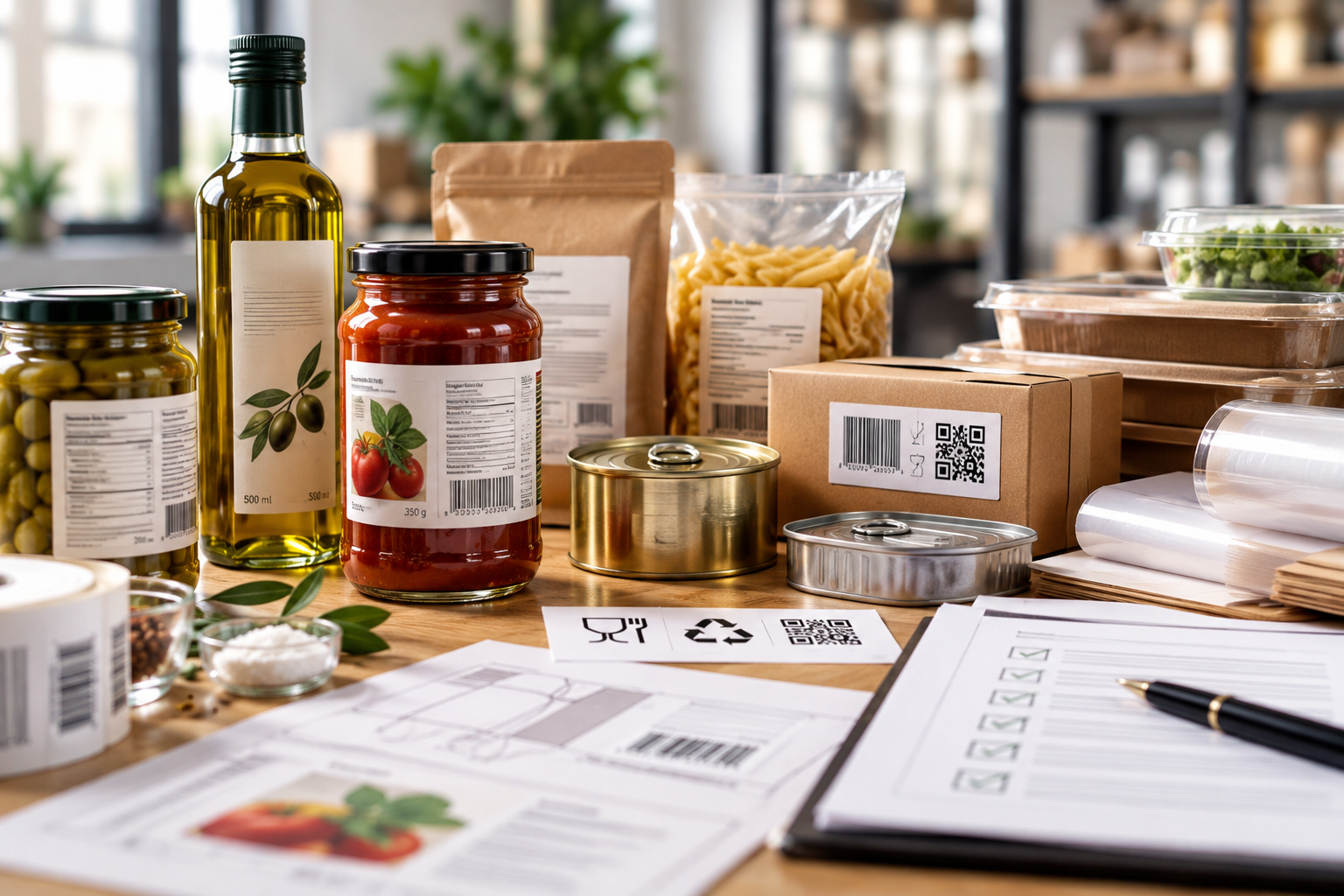
For a food or beverage product, the journey from production to the consumer involves three aspects that are often underestimated: packaging materials, labelling and product standardisation. All three have legal implications, a direct impact on costs and a decisive role in gaining access to distribution channels such as retail chains, food service and export markets.
Criteria for Selecting Packaging Materials
Packaging protects, preserves, informs, promotes the product and contributes to its overall cost. The choice of packaging material is determined by four questions: what type of food is involved (acidic, fatty, alcoholic, liquid or dry), how long it needs to be preserved, how and where it is transported, and through which distribution channel it is marketed. The material is selected based on these answers, rather than serving as the starting point. Technologies such as heat treatment after sealing, vacuum packaging or modified atmosphere packaging can significantly extend shelf life, but they cannot compensate for deficiencies in raw materials or hygiene practices.
Food Contact Materials and Declarations of Compliance
Regulation (EC) No 1935/2004 establishes that no material intended to come into contact with food may transfer substances to it in quantities that could endanger human health or alter its composition. This applies to jars, lids and films, as well as adhesives and printing inks used on labels. For plastics, Regulation (EU) No 10/2011 establishes an overall migration limit of 10 mg/dm² and specific migration limits for individual substances.
The key document is the supplier’s Declaration of Compliance, which also specifies the conditions of use: temperature, contact time and type of food. A container approved for cold water is not automatically suitable for hot sauce, and the “glass and fork” symbol alone is not sufficient evidence of compliance during an inspection.
Two developments in 2026 further highlight its importance. First, from 12 August 2026, food contact packaging may not be placed on the EU market if PFAS levels reach or exceed the limits established by Regulation (EU) 2025/40: 25 ppb for any individual substance, 250 ppb for the sum of PFAS and 50 ppm for total PFAS. This requirement primarily concerns paper-based packaging with grease-resistant coatings. Second, Regulation (EU) 2024/3190 prohibits bisphenol A and other hazardous bisphenols in food contact materials, subject to transitional periods. For businesses using metal lids or containers, the key question to ask suppliers is whether the internal coating complies with Regulation (EU) 2024/3190, supported by a Declaration of Compliance.
Mandatory Labelling Information
Everything stated on the packaging constitutes information provided both to the competent inspection authorities and to consumers. Article 9 of Regulation (EU) No 1169/2011 specifies the mandatory particulars: the name of the food, list of ingredients, allergens, quantitative indication of ingredients (QUID) where required, net quantity, date marking, storage conditions, responsible food business operator, country of origin where required, instructions for use, alcoholic strength for beverages containing more than 1.2% alcohol by volume, and nutrition declaration.
The most common shortcomings are practical: using a brand name instead of the legal name of the food, listing additives without their functional class, omitting QUID when an ingredient is highlighted in the product name or imagery, and using lettering below the minimum x-height of 1.2 mm (0.9 mm only for packaging with a largest surface area of less than 80 cm²). Health claims are permitted only if they are included in the EU register under Regulation (EC) No 1924/2006, while indications such as “Organic” or PDO/PGI require participation in the relevant certification and control system.
Allergens and Precautionary Allergen Labelling
The 14 allergens listed in Annex II to Regulation (EU) No 1169/2011 must be indicated in the list of ingredients, with typographical emphasis that clearly distinguishes them from the other ingredients. Regarding the precautionary statement “may contain”, the new Codex approach provides that it should be used only when a documented risk assessment identifies a residual risk exceeding established action levels, after appropriate control measures have been implemented. Codex guidelines do not automatically create legal obligations; they become binding only when incorporated into national or regional legislation. Nevertheless, the direction is clear: documented allergen management throughout production is a prerequisite for any related labelling statement.
Date Marking and Shelf-Life Documentation
The indication “best before” relates to quality, while “use by” concerns the safety of highly perishable foods, which may no longer be marketed after the specified date. In both cases, shelf life is determined by the producer on the basis of documented evidence, including microbiological, physicochemical and sensory testing under actual storage conditions, and must be reassessed whenever there is a change in the recipe, packaging material or production process.
Batch Numbers, GS1 Coding and Product Technical Data Sheets
The batch number, provided for under Directive 2011/91/EU, is one of the most cost-effective means of protecting a business. Combined with records of raw materials and customers, it enables the recall of a specific production batch rather than every product bearing the same product code.
A barcode, by contrast, is not a legal obligation but a commercial requirement imposed by retail chains. The Global Trade Item Number (GTIN) is issued through GS1, and each flavour, size or packaging format requires its own code. For most businesses, two barcode symbols are sufficient: EAN-13 on individual retail units and ITF-14 on shipping cartons. The GS1 Sunrise 2027 initiative is preparing retail point-of-sale systems to read two-dimensional barcodes, which can also carry batch numbers and expiry dates. Reserving space for a QR code in the next label design entails no additional cost at this stage.
The final element of product standardisation is the product technical data sheet: a one-page document containing product identification, composition, allergens, nutritional information, physicochemical and microbiological characteristics, shelf life, packaging and logistics information. It is the first document requested by buyers in retail, food service or private-label markets.
Requirements by Distribution Channel
Local retailers require complete labelling and consistent quality. Retail chains additionally require barcodes, technical data sheets, a HACCP system, and often certification and product liability insurance. The food service sector requires larger packaging formats, consistent performance in recipes and clear information on shelf life after opening. Export markets require labelling in the language of the destination market and compliance with the requirements of the importing country. Understanding these requirements before an order is placed often makes the difference between a business relationship that develops successfully and an opportunity that is lost.
Proper product standardisation is established once and then consistently applied. Its cost is relatively low compared with the expense of reprinting labels, having goods detained or losing an order that ultimately does not proceed.
References
Legislation and Official Documents
- Regulation (EC) No 1935/2004 on materials and articles intended to come into contact with food. OJ L 338, 13.11.2004.
- Commission Regulation (EU) No 10/2011 on plastic materials and articles intended to come into contact with food. OJ L 12, 15.1.2011.
- Commission Regulation (EU) 2024/3190 on the use of bisphenol A (BPA) and other bisphenols in food contact materials. OJ L, 31.12.2024.
- Regulation (EU) 2025/40 on packaging and packaging waste. OJ L, 2025/40, 22.1.2025.
https://eur-lex.europa.eu/eli/reg/2025/40/oj - Regulation (EU) No 1169/2011 on the provision of food information to consumers. OJ L 304, 22.11.2011.
- Regulation (EC) No 1924/2006 on nutrition and health claims made on foods. OJ L 404, 30.12.2006.
- Directive 2011/91/EU on indications or marks identifying the lot to which a foodstuff belongs. OJ L 334, 16.12.2011.
- Regulation (EC) No 178/2002, Articles 18–19. OJ L 31, 1.2.2002.
- Codex Alimentarius Commission (2026). Guidelines on the Use of Precautionary Allergen Labelling, annex to the General Standard for the Labelling of Pre-packaged Foods (CXS 1-1985). FAO/WHO.
- Codex Alimentarius (2020). Code of Practice on Food Allergen Management for Food Business Operators (CXC 80-2020). FAO/WHO.
- European Commission (2026). Commission Notice – Guidance Document on Regulation (EU) 2025/40, C/2026/3084. OJ C, 10.6.2026.
Technical Documentation
- GS1. GS1 General Specifications. GS1 AISBL.
- GS1. Sunrise 2027: Transition to 2D Barcodes at Retail Point-of-Sale. GS1 AISBL.